Overlap execution
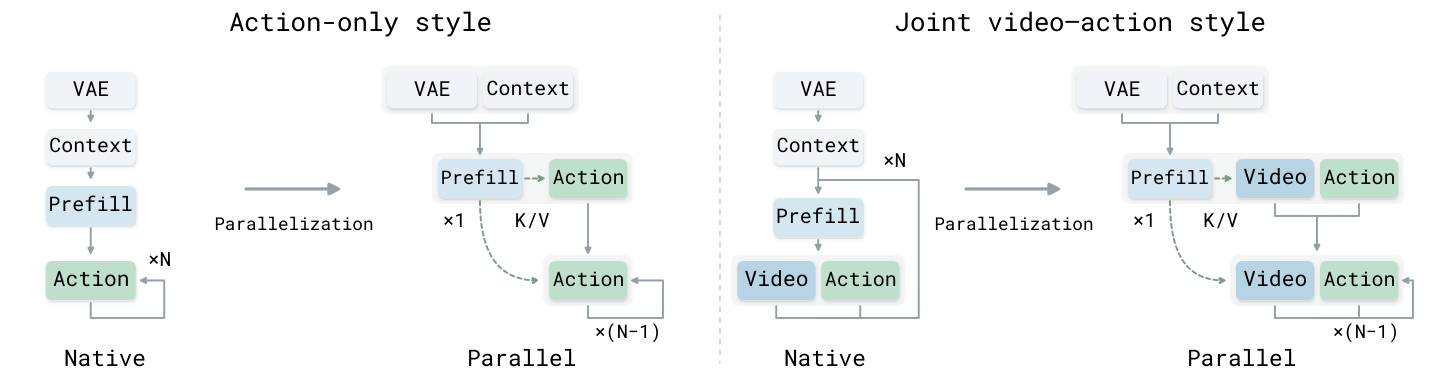
Release observation keys and values layer by layer, allowing prediction to overlap the remaining observation computation.
WORLD ACTION MODELS · REAL-TIME INFERENCE
Parallel execution and adaptive computation for responsive robot control. No additional model training.
1 Tsinghua University2 YuanxingGuangnian Robotics3 Nanjing University
FastWAM speedup
24.09 ms average inferenceOpenWAM speedup
63.09 ms average inferenceOpenWAM real-world success
33.6% → 70.8% across five tasksSimulation speedups relative to original Native execution, averaged across four settings. Real-world success is averaged separately over five tasks.
THE IDEA
World action models predict actions—and sometimes future video—from the current observation. Their inference cost can leave a robot waiting while its environment continues to move.
RealtimeWAM coordinates three decisions: when each branch runs, which observation tokens need fresh features, and how many full Transformer evaluations a prediction receives.
We evaluate the framework on FastWAM and OpenWAM across RoboTwin, LIBERO, LIBERO-Plus, and five real-world tasks.
IN ACTION
Recorded task demonstrations.
Videos retain their source playback timing.
Pick and place from a moving conveyor.
Place the handle onto a rack on a level tabletop.
Transfer a ball from the conveyor into a bowl.
Catch and place a can on an inclined tabletop.
Each task was evaluated over 50 trials per backbone and inference configuration. These videos illustrate individual executions.
METHOD
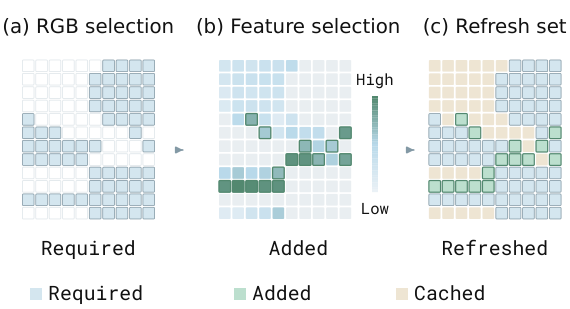
The execution schedule and the amount of fresh computation are designed together.
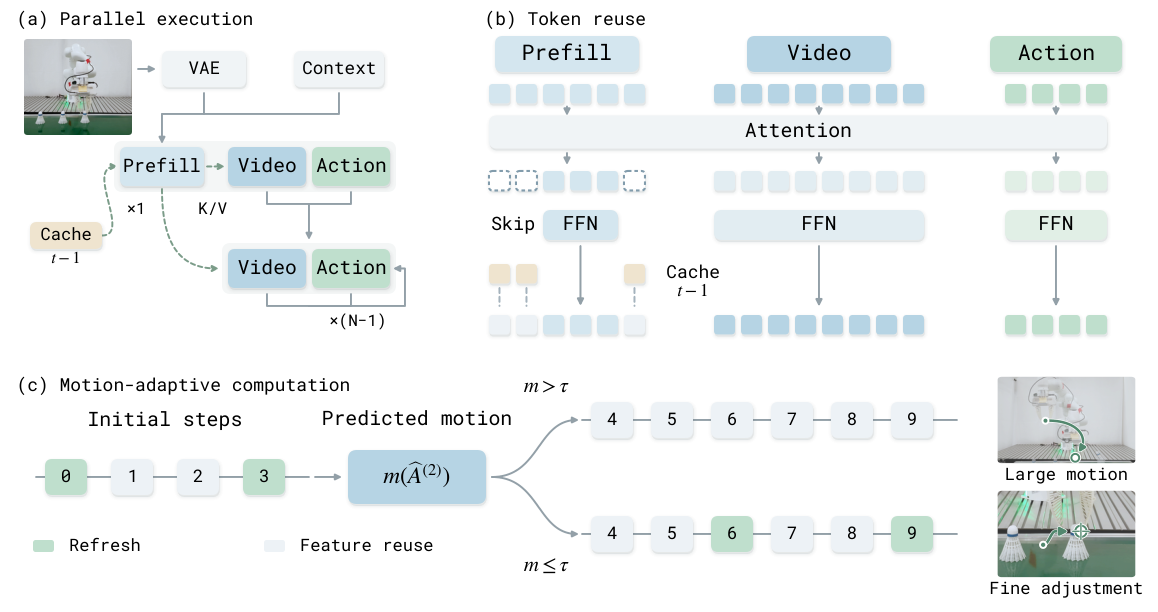
Release observation keys and values layer by layer, allowing prediction to overlap the remaining observation computation.
Use RGB and feature changes to select observation updates. Fill available execution capacity with informative tokens.
Decode a coarse action after two full evaluations. Predicted displacement determines whether to add two more.
EXPERIMENTS
| Method | RoboTwin Clean | RoboTwin Random | LIBERO | Plus | Average success | Latency (ms) | Speedup |
|---|---|---|---|---|---|---|---|
| Native | 91.88 | 91.78 | 97.60 | 49.80 | 82.77 | 214.33 | 1.00× |
| VLA-Cache | 80.00 | 83.20 | 97.00 | 48.60 | 77.20 | 115.55 | 1.85× |
| TeaCache | 81.42 | 90.86 | 97.05 | 49.20 | 79.63 | 49.28 | 4.35× |
| ToCa | 91.35 | 91.24 | 94.55 | 49.15 | 81.57 | 102.66 | 2.09× |
| BAC | 91.67 | 89.53 | 97.50 | 51.55 | 82.56 | 67.14 | 3.19× |
| RealtimeWAM (Ours) | 92.04 | 90.50 | 97.25 | 51.20 | 82.75 | 24.09 | 8.90× |
| Method | RoboTwin Clean | RoboTwin Random | LIBERO | Plus | Average success | Latency (ms) | Speedup |
|---|---|---|---|---|---|---|---|
| Native | 93.64 | 94.06 | 99.30 | 64.75 | 87.94 | 672.83 | 1.00× |
| VLA-Cache | 93.36 | 89.94 | 98.40 | 62.70 | 86.10 | 400.26 | 1.68× |
| TeaCache | 90.42 | 94.12 | 98.60 | 63.80 | 86.74 | 245.99 | 2.74× |
| ToCa | 93.42 | 93.98 | 98.10 | 63.70 | 87.30 | 440.42 | 1.53× |
| BAC | 93.52 | 91.96 | 98.90 | 66.70 | 87.77 | 305.08 | 2.21× |
| RealtimeWAM (Ours) | 92.78 | 94.02 | 99.00 | 63.85 | 87.41 | 63.09 | 10.67× |
Averages weight the four settings equally. Caching baselines use compilation and CUDA Graph replay. Speedups use original Native latency as the reference. Hardware: a modified 48 GiB RTX 4090.
REAL-WORLD SUCCESS
Across five tasks, average success improves by 17.2 percentage points on FastWAM and 37.2 points on OpenWAM.
TASK-BY-TASK RESULTS
| Task | Native | RealtimeWAM | ||
|---|---|---|---|---|
| Success (%) ↑ | Latency (ms) ↓ | Success (%) ↑ | Latency (ms) ↓ | |
| Three shuttlecocks | 24.0 | 210.36 | 40.0 | 24.33 |
| Carrot to plate | 46.0 | 209.74 | 74.0 | 21.86 |
| Hang mug | 72.0 | 211.08 | 70.0 | 25.07 |
| Tennis ball to bowl | 26.0 | 210.52 | 34.0 | 23.24 |
| Rolling can to bowl | 10.0 | 211.85 | 46.0 | 24.11 |
| Average | 35.6 | 210.71 | 52.8 | 23.72 |
| Task | Native | RealtimeWAM | ||
|---|---|---|---|---|
| Success (%) ↑ | Latency (ms) ↓ | Success (%) ↑ | Latency (ms) ↓ | |
| Three shuttlecocks | 4.0 | 640.28 | 68.0 | 68.61 |
| Carrot to plate | 66.0 | 638.56 | 96.0 | 62.12 |
| Hang mug | 82.0 | 642.15 | 82.0 | 65.36 |
| Tennis ball to bowl | 16.0 | 639.47 | 76.0 | 64.85 |
| Rolling can to bowl | 0.0 | 643.89 | 32.0 | 65.43 |
| Average | 33.6 | 640.87 | 70.8 | 65.27 |
50 trials per task, backbone, and inference configuration. Latency is measured during local inference; averages weight the five tasks equally.
COMPONENT ABLATIONS
OpenWAM on RoboTwin. Each variant changes the indicated component of the full method.
| Configuration | Success (%) ↑ | First forward (ms) ↓ | Request (ms) ↓ |
|---|---|---|---|
| Ours (full) | 93.4 | 30.96 | 63.76 |
| w/o token reuse | 93.8 | 37.41 | 72.10 |
| Random tokens | 91.3 | 30.75 | 62.32 |
| w/o capacity filling | 92.1 | 30.76 | 61.78 |
| Random gate | 91.1 | 31.02 | 64.77 |
| Fixed 2F | 89.6 | 31.11 | 54.70 |
| Fixed 4F | 93.7 | 30.87 | 95.26 |
Request is the mean inference latency measured over complete rollouts. Fixed 2F and 4F retain the normal token policy; the random gate preserves the adaptive gate’s budget proportions.
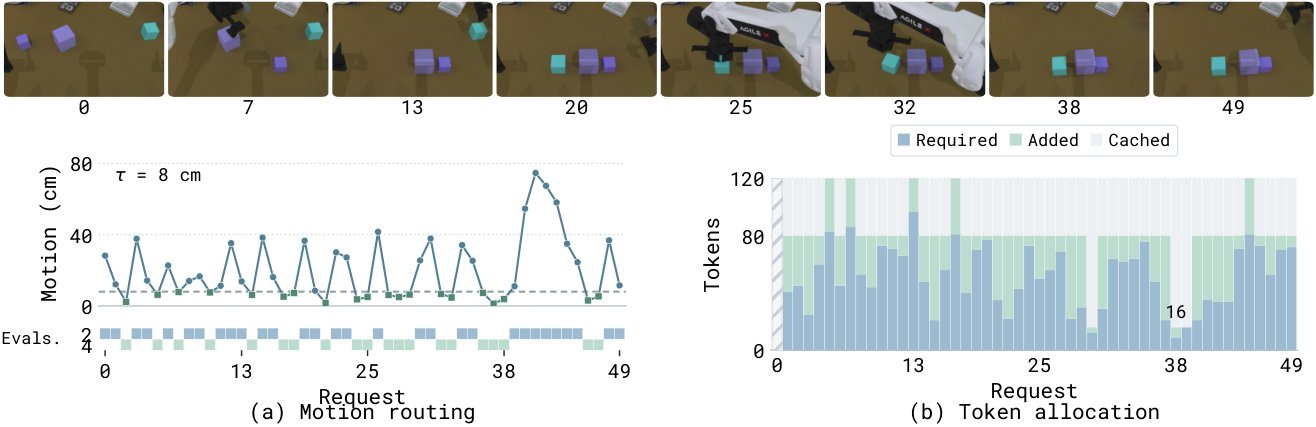
A CLOSER LOOK
Observation updates and predictive refinement vary across successive action requests.
OPEN SOURCE
All three components are available as a compact external runtime. Use the original OpenWAM model and weights without editing upstream source.
Overlap independent branch computation, with compiled phases, fused operators and CUDA Graph replay.
Refresh selected observation positions and reuse the remaining FFN outputs across requests. Enable with reuse_tokens=True.
Select two or four full Transformer evaluations while retaining ten Euler updates. Enable with adaptive_2f4f=True.
Parallel execution is enabled by default. Token reuse and adaptive refinement introduce approximation and are disabled by default. This release covers OpenWAM; FastWAM and the full closed-loop evaluation suite are outside its scope. Results above are from the paper.
CITATION
Please cite the paper if you use RealtimeWAM in your research.
@misc{liu2026realtimewam,
  title         = {RealtimeWAM: How Fast Can I Run My World Action Model?},
  author        = {Huanan Liu and Ye Li and Kangye Ji
                   and Xiaoyu Chen and Hanyun Cui and Yutian Shen
                   and Yuan Meng and Chenglei Wu and Jingyan Jiang
                   and Bo Li and Zhi Wang},
  year          = {2026},
  eprint        = {2610.10079},
  archivePrefix = {arXiv},
  primaryClass  = {cs.RO},
  doi           = {10.48550/arXiv.2610.10079},
  url           = {https://arxiv.org/abs/2610.10079}
}THE PAPER
How Fast Can I Run My World Action Model?